
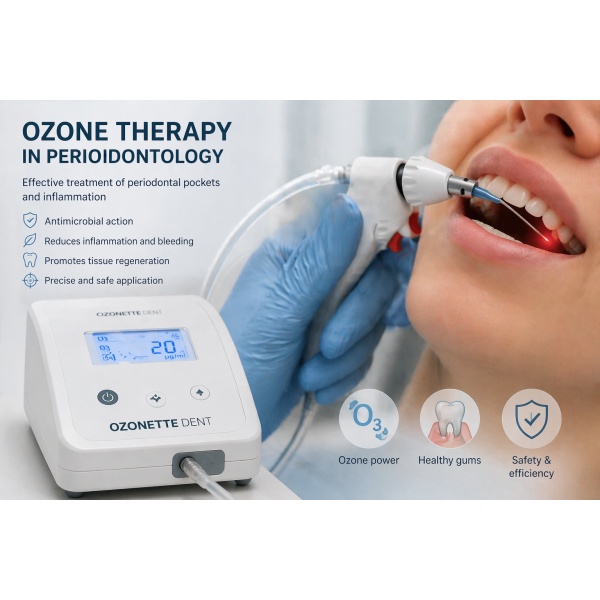
Periodontal diseases are among the most распространени chronic conditions in dentistry, affecting the gingiva, periodontal ligament, cementum, and alveolar bone. The most common forms – gingivitis and periodontitis – are characterized by inflammation, bleeding, periodontal pocket formation, and progressive bone loss.
The primary etiological factor is the bacterial biofilm, which accumulates on tooth surfaces and within the subgingival area.
In recent years, ozone therapy has emerged as a powerful adjunctive method that:
- improves infection control
- supports healing processes
- reduces the need for aggressive interventions
Modern systems such as OZONETTE DENT enable precise and targeted ozone application directly into periodontal pockets.
Pathogenesis of Periodontal Diseases
The development of periodontitis involves several stages:
1. Bacterial colonization
Accumulation of pathogens such as:
- Porphyromonas gingivalis
- Aggregatibacter actinomycetemcomitans
- Treponema denticola
2. Biofilm formation
The biofilm:
- protects bacteria
- reduces the effectiveness of antiseptics
- creates persistent infection
3. Inflammatory response
The immune response leads to:
- destruction of connective tissue
- bone resorption
- formation of periodontal pockets
Mechanism of Action of Ozone
Ozone (O₃) exerts a multi-factorial effect:
Antimicrobial action
- oxidizes microbial cell membranes
- destroys bacteria, viruses, and fungi
Biofilm disruption
- breaks down the organic matrix
- exposes bacteria to treatment
Anti-inflammatory effect
- reduces inflammatory mediators
- decreases swelling and bleeding
Biostimulation
- improves microcirculation
- stimulates tissue regeneration
Key advantage:
gaseous ozone penetrates deeply into periodontal pockets and hard-to-reach areas
Clinical Applications
1. Gingivitis
- reduces inflammation
- decreases bleeding
- improves gingival health
2. Chronic periodontitis
- reduces bacterial load
- supports pocket treatment
- stabilizes disease progression
3. Deep periodontal pockets
- direct ozone delivery
- effective disinfection
- reduction in pocket depth
4. Maintenance therapy
- long-term control
- prevention of relapse
5. Peri-implantitis
- reduces infection around implants
- supports healing
Methods of Application
Gaseous ozone
- direct application into pockets,
- highest effectiveness.
Ozonated oils
- prolonged action,
- home-care support.
Combined therapy
- scaling + ozone,
- curettage + ozone.
Best results are achieved with
controlled application using devices such as OZONETTE DENT.
Advantages of Ozone Therapy
Clinical benefits:
- deep disinfection,
- biofilm disruption,
- accelerated healing.
Practice benefits:
- improved outcomes,
- modern positioning,
- competitive advantage.
Benefits for Patients
- painless procedure,
- reduced bleeding,
- faster recovery,
- reduced need for antibiotics.
Clinical Outcomes
Clinical evidence shows:
- reduction in periodontal pocket depth,
- decreased bacterial load,
- improvement in gingival indices,
- stabilization of periodontal condition.
Safety and Protocol
For safe application:
- use controlled concentrations,
- operate certified devices,
- avoid inhalation exposure.
OZONETTE DENT ensures:
- precise dosing,
- safety,
- ease of use.
Combination with Other Therapies
Ozone therapy can be successfully combined with:
- scaling and polishing,
- curettage,
- laser therapy,
- surgical procedures.
Role in Modern Periodontology
Ozone therapy:
- does not replace but enhances standard treatment,
- improves clinical outcomes,
- reduces complications.
Conclusion
Ozone therapy in periodontology is a powerful, scientifically supported method for infection control and improvement of periodontal tissue health. Due to its deep penetration and multi-factorial action, it has become a valuable tool in modern dental practice.
Contact us to implement ozone therapy in your practice and offer more effective and modern periodontal treatment.
- It is offered with training on how to operate the device and training on its application in dentistry.
- For daily hygiene use ACTIVOZONE DENTAL FRESH.
FAQ – Frequently Asked Questions
Is ozone effective for periodontitis?
Yes, it significantly reduces bacteria and inflammation.
Can it replace standard treatment?
No, it is used as an adjunctive therapy.
Is it suitable for implants?
Yes, especially in peri-implantitis.
Is ozone therapy safe?
Yes, when used correctly and in controlled doses.
1 Comments
Здравейте!
При проблеми с венците задължително вземайте пробиотици. Препоръчвам Probiotic 5 y K-Butyrate. Ще имате много бързи резултати с тях, в рамките на седмица или две. На мен ми изчезна джоб близо до кътник без да разбера. Препоръчвам всичко от марка VEGAFARMA.
Leave a Comment