
Ozone Therapy for Herniated Disc – A Modern Minimally Invasive Approach
What is a Herniated Disc
A herniated disc is a condition in which part of an intervertebral disc moves out of its normal position and may compress the nerve structures around the spine. This often leads to back pain, numbness, or weakness in the limbs.
The spine is composed of vertebrae, between which are located the intervertebral discs. These discs function as shock absorbers and allow the spine to move and absorb mechanical stress.
Each disc has two main components:
-
Annulus fibrosus – a strong outer fibrous ring
-
Nucleus pulposus – a gel-like inner core
When the annulus fibrosus weakens or tears, part of the nucleus pulposus may protrude and press on the nerve roots.
Herniated discs most commonly occur in the lumbar spine, particularly between the L4–L5 and L5–S1 vertebrae, which bear the greatest mechanical load.
How Common is a Herniated Disc
Lower back pain is one of the most common health problems worldwide. It is estimated that up to 80% of people experience lower back pain at least once in their lifetime.
Among patients suffering from back pain, approximately 5–15% are affected by a herniated disc.
The most affected age group is between 30 and 50 years, when the spine is subjected to significant mechanical stress.
Main Causes of Herniated Disc
The development of a herniated disc can be associated with several factors.
Degenerative Changes
With age, intervertebral discs gradually lose part of their water content and elasticity.
Excessive Physical Strain
Repeated lifting of heavy objects can increase the risk of disc injury.
Poor Posture
Prolonged sitting and incorrect posture can increase the load on the spine.
Trauma
Sudden movements or spinal injuries may cause tearing of the annulus fibrosus.
Symptoms of Herniated Disc
Symptoms may vary depending on the location and size of the herniation.
The most common symptoms include:
-
lower back pain
-
pain radiating to the leg (sciatica)
-
numbness or tingling
-
muscle weakness
-
limited mobility
Pain often worsens when sitting, bending forward, or during physical activity.
Biomechanics of Intervertebral Discs
Intervertebral discs act as shock absorbers between the vertebrae and allow flexibility of the spine. Their primary function is to distribute mechanical stress during movement.
The nucleus pulposus contains a high amount of water and proteoglycans that maintain its elasticity. With aging, water content decreases, making the disc more vulnerable to damage.
This process is known as intervertebral disc degeneration and is one of the main causes of herniated discs.
How a Herniated Disc Develops
The development of a herniated disc may occur in several stages:
-
Disc protrusion – the disc bulges outward
-
Disc prolapse – the nucleus pulposus presses against the annulus fibrosus
-
Disc extrusion – part of the nucleus pulposus moves outside the disc
-
Sequestration – a fragment of the disc separates completely
These changes may lead to compression of nerve roots and severe pain.
Mechanism of Pain
Pain associated with a herniated disc is caused not only by mechanical pressure on the nerves but also by inflammatory processes.
When the nucleus pulposus moves outside the disc, it may trigger inflammatory reactions that lead to:
-
release of inflammatory mediators
-
irritation of nerve endings
-
increased pain sensation.
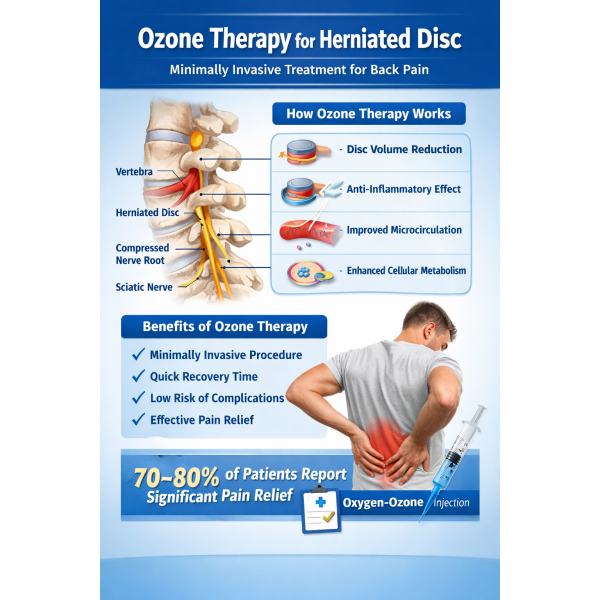
Ozone Therapy for Herniated Disc
Ozone therapy is a medical method that uses a mixture of oxygen and ozone (O₂–O₃).
This therapy is considered a minimally invasive approach that may help reduce pain and inflammation in patients with herniated discs.
In some cases, the ozone mixture is injected near the affected disc or nerve root.
How Ozone Therapy Works
Reduction of Disc Volume
Ozone may trigger chemical reactions that lead to dehydration of the nucleus pulposus and reduction of disc volume. This reduces pressure on nerve structures.
Anti-Inflammatory Effect
Ozone may help reduce inflammatory processes around nerve roots.
Improved Microcirculation
Improved blood flow supports the delivery of oxygen and nutrients to affected tissues.
Improved Cellular Metabolism
Ozone may enhance oxygen release to cells and support metabolic processes.
Scientific Research
In recent years, numerous scientific studies have examined the effects of ozone therapy in patients with herniated discs.
Some clinical studies report that between 70% and 80% of patients experience significant pain reduction after oxygen-ozone therapy.
Other observations suggest that the benefits may persist long term in some patients.
Advantages of Ozone Therapy
Among the main advantages of this method are:
-
minimally invasive procedure
-
short recovery time
-
possibility of outpatient treatment
-
low risk of complications
Because of these characteristics, ozone therapy is considered a potential alternative or complementary method to conventional treatments.
Ozonated Products as Part of a Wellness Approach
In addition to medical procedures, ozone is also used in the development of ozonated products that may be included in daily health care routines.
OE PREMIUM – Support for Antioxidant Protection
OE PREMIUM is a product designed to support antioxidant protection and metabolic balance in the body.
Antioxidants play an important role in protecting cells from oxidative stress.
OE GAST – Support for Digestive Balance
OE GAST supports the normal function of the digestive system and digestive comfort.
OE CAPS – A Convenient Form for Daily Intake
OE CAPS is a capsule form of ozonated compounds that allows convenient daily intake as part of a wellness routine.
Prevention of Herniated Disc
To reduce the risk of developing a herniated disc, the following measures are recommended:
-
regular physical activity
-
exercises to strengthen the back muscles
-
proper posture
-
maintaining a healthy body weight
-
avoiding excessive strain
Conclusion
A herniated disc is a common condition that can significantly affect quality of life.
Modern medical approaches include various therapeutic methods, among which ozone therapy is being investigated as a minimally invasive procedure that may help reduce pain and improve spinal function.
As part of a broader wellness approach, products such as OE PREMIUM, OE GAST, and OE CAPS may be included in daily health care routines.
FAQ – Frequently Asked Questions
What is a herniated disc?
A herniated disc is a condition in which part of an intervertebral disc moves out of place and may compress nearby nerves.
Can ozone therapy help with a herniated disc?
Ozone therapy is being studied as a minimally invasive method that may help reduce pain and inflammation.
When is surgery required for a herniated disc?
Surgery may be necessary in severe cases when conservative treatment does not provide relief.
2 Comments
Imam diskova hernia ot 4 godini mojeli da me lekuvate sas ozonoterapiq
00 359 87 8941327 обадете се на този телефон за консултация. МЕДИКОЗОН Ако е дискова херния най-вероятно ще ви помогнат.
Leave a Comment