
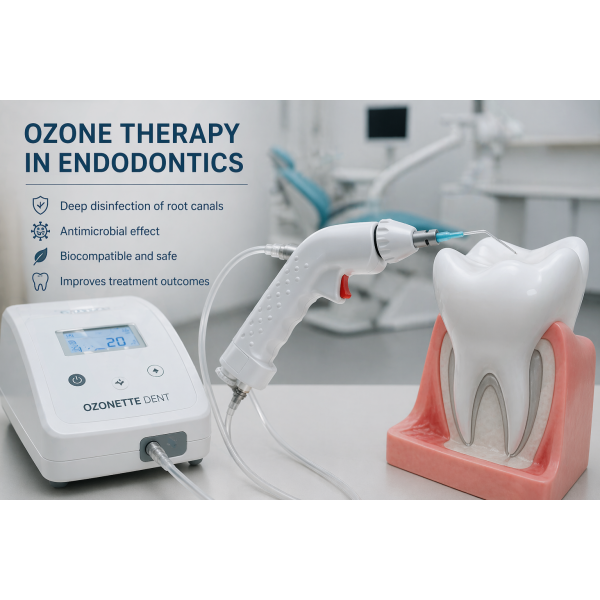
Endodontics is a key field in modern dentistry, focused on the treatment of the dental pulp and periapical tissues, with the primary goal of preserving the natural tooth. The success of endodontic therapy largely depends on the effective disinfection of the root canal system, a complex anatomical structure that includes main canals, lateral branches, and dentinal tubules.
Despite advancements in instrumentation and irrigation solutions, complete elimination of microorganisms remains a challenge. In this context, ozone therapy has emerged as a highly effective adjunctive method.
Modern devices such as OZONETTE DENT allow precise and controlled ozone delivery, ensuring deep penetration and high antimicrobial efficiency.
Microbiology of Endodontic Infections
Root canals provide a low-oxygen environment that favors the growth of anaerobic bacteria. Common pathogens include:
- Enterococcus faecalis,
- Fusobacterium nucleatum,
- Porphyromonas gingivalis.
These microorganisms form a biofilm, which:
- is resistant to conventional antiseptics,
- penetrates dentinal tubules,
- can cause persistent infections.
Mechanism of Action of Ozone in Endodontics
Ozone (O₃) is a powerful oxidizing agent with a broad antimicrobial spectrum.
Key effects:
- Disruption of microbial cell membranes,
- Oxidation of organic components within biofilms,
- Inactivation of toxins,
- Improved local oxygenation.
The most important advantage:
ozone penetrates dentinal tubules where conventional irrigants cannot reach
Clinical Applications
1. Primary Endodontic Treatment
Ozone is used as an adjunct to:
- mechanical instrumentation,
- irrigation (NaOCl, EDTA),
result:
- improved canal disinfection,
- reduced bacterial load.
2. Persistent Infections
In cases involving:
- chronic inflammation,
- post-treatment pain,
- non-healing lesions,
ozone:
- eliminates resistant microorganisms,
- supports tissue regeneration.
3. Retreatment
During retreatment procedures:
- removal of previous filling materials,
- disinfection of residual infection,
ozone improves overall treatment prognosis.
4. Apical Lesions
- supports healing of periapical tissues,
- reduces inflammation.
Methods of Application
Ozone can be applied in several forms:
Gaseous ozone
- direct application into the root canal,
- highest antimicrobial effectiveness.
Ozonated liquids
- complementary role.
Specialized delivery systems
- controlled flow,
- precise dosage.
Devices such as OZONETTE DENT provide:
- stable delivery,
- safety,
- precision.
Advantages of Ozone Therapy
Clinical benefits:
- deeper disinfection,
- effective biofilm disruption,
- reduced risk of reinfection.
Practice benefits:
- improved treatment success rates,
- differentiation of the clinic,
- integration of advanced technology.
Benefits for Patients
- reduced post-operative discomfort,
- faster recovery,
- higher treatment success,
- lower risk of retreatment.
Clinical Outcomes
Clinical observations and studies indicate:
- significant reduction in bacterial load,
- improved canal sterility,
- enhanced healing of periapical tissues,
ozone is particularly effective against resistant strains.
Safety and Protocol
For safe application:
- use controlled concentrations,
- operate certified devices,
- avoid gas leakage beyond the canal.
OZONETTE DENT ensures:
- precise control,
- safe application,
- ease of use.
Role in Modern Endodontics
Ozone therapy does not replace conventional methods but enhances and complements them by:
- improving treatment efficiency,
- reducing complications,
- supporting long-term success.
Conclusion
Ozone therapy in endodontics represents a highly effective and scientifically supported approach to improving root canal disinfection. Thanks to its ability to penetrate deep structures and eliminate resistant microorganisms, it has become a valuable tool in modern dental practice.
Contact us to learn how to implement ozone therapy in your endodontic practice and improve treatment success rates.
- It is offered with training on how to operate the device and training on its application in dentistry.
- For daily hygiene use ACTIVOZONE DENTAL FRESH.
FAQ – Frequently Asked Questions
Is ozone effective in root canal treatment?
Yes, it significantly improves disinfection and reduces bacterial load.
Can it replace standard irrigation?
No, it is used as a complementary method.
Is it suitable for retreatment?
Yes, especially in resistant or persistent infections.
Is ozone therapy safe?
Yes, when applied correctly and in controlled doses.